Computers for agents. Servers for products.
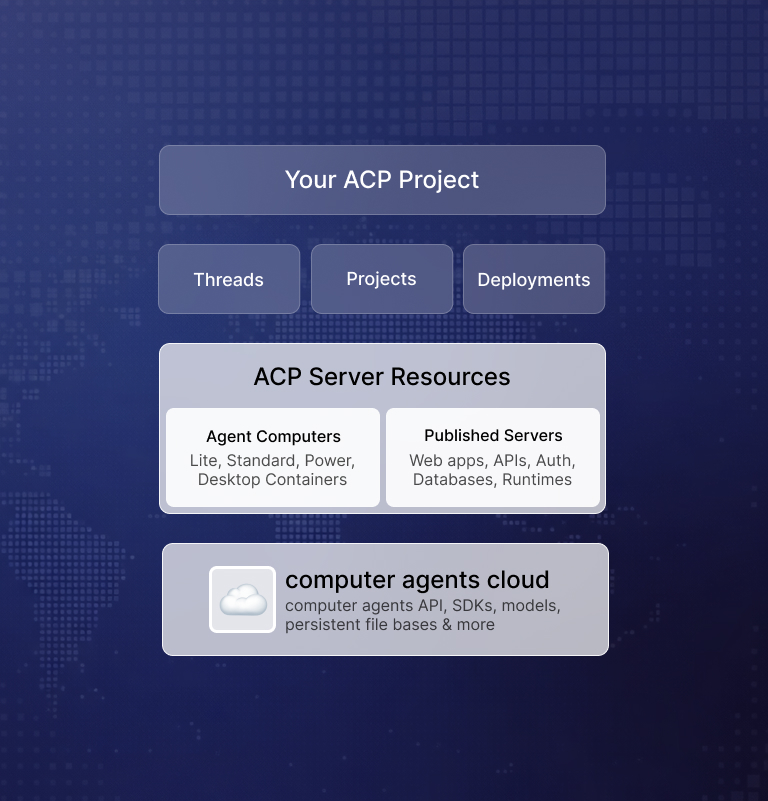
ACP gives agents stateful computers to work on and gives teams deployable resources to ship. Threads, projects, computers, and published servers all stay in one execution system.
Why choose
computer agents
servers?
Virtual operators, not fixed endpoints
Any agent can receive input from email, uploads, APIs, threads, schedules, or webhooks, work on it in a real computer, and publish the result as a live resource. ACP behaves more like a system for digital employees than a narrow endpoint wrapper.
Fair pricing that follows real usage
ACP pricing tracks actual runtime and deployed resource usage instead of forcing teams into oversized always-on infrastructure. Start small, prove value, and scale the parts that are actually doing work.
Highly optimized compute with four container sizes
Choose Lite, Standard, Power, or Desktop depending on the workload. Keep simple automation lean, move heavier coding and research to stronger profiles, and only pay for larger environments when the work needs them.
Bring your own model when you need control
Run with managed ACP models by default or connect your own inference endpoint when procurement, security, or provider strategy requires it. ACP does not force a single model path on every team.
Deep runtime customization
Customize environments with runtimes, packages, secrets, MCP tools, setup scripts, and Docker-level behavior. ACP is not just a glossy abstraction over a fixed sandbox. You can shape the runtime around the system you are building.
Infrastructure without infrastructure work
ACP handles the operational plumbing: execution, state, deployment, triggers, coordination, and persistent project context. Teams stay focused on systems and outcomes instead of stitching infra together by hand.
Choose the runtime. Ship the surface.
Computers define how agents work internally. Servers define what ACP can publish externally. Together they cover the full path from execution to product.
Container types
Lean compute for lightweight automation, routing, short follow-ups, and agents that mostly orchestrate other work.
The balanced default for most ACP threads: coding, browsing, file work, research, and day-to-day agent execution.

More headroom for heavy coding, larger installs, deeper analysis, and build-heavy or tool-heavy execution.
Interactive compute with GUI access for workflows that need real desktop apps, visual tooling, or browser-first tasks.
Server types you can deploy



Publish from humans, agents, or both.
ACP gives teams one resource model across the platform, the SDKs, and running agent workflows. Humans can ship manually. Agents can publish as part of the work.
Humans can ship directly
Publish from the ACP platform or from the SDK when you want explicit control over what gets deployed and when it goes live.
Agents can publish as part of work
Threads can generate assets, prepare code, and ship functions, auth services, web apps, databases, and runtimes without leaving the same project boundary.
One model, many surfaces
The same computers, projects, permissions, and state can power internal workflows and public-facing infrastructure. You do not need a separate publishing stack.